

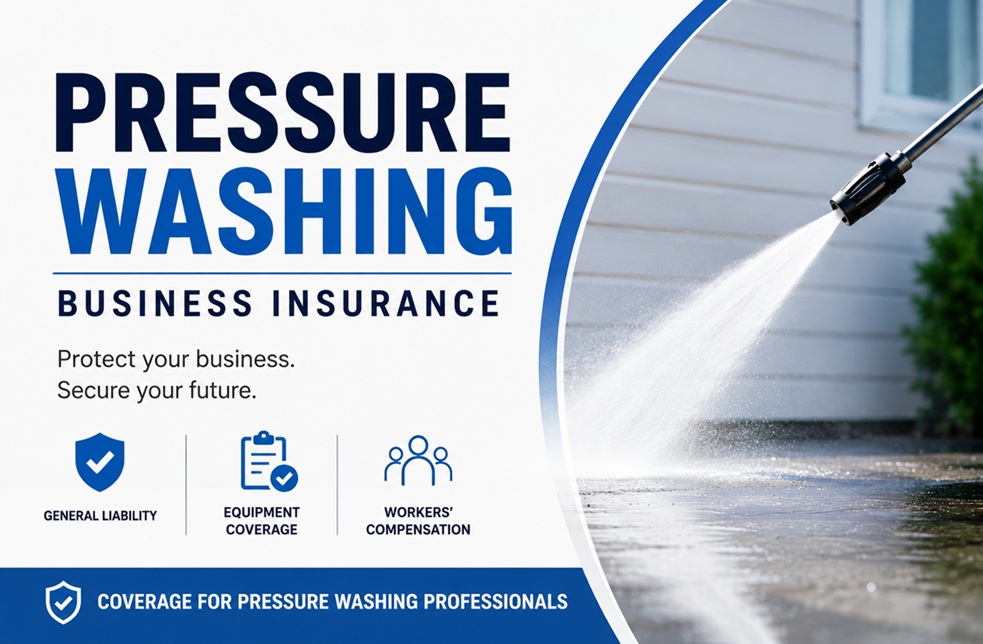
Pressure washing might look straightforward – but from an insurance perspective, it carries real risk. Water damage to a client’s property, broken windows from spray pressure, a slip and fall on a wet surface — these aren’t rare occurrences in this industry.
Here’s what you need to know: most pressure washing businesses need general liability insurance as a baseline, and depending on your operation, you’ll likely add commercial auto, tools & equipment, and workers’ comp. Total annual costs for a solo operator typically run $1,000–$2,500.
Insurance Cost Breakdown for Pressure Washing
| Coverage Type | What It Covers | Avg. Annual Cost |
| General Liability | Property damage, client injuries, completed operations | $500 – $1,200 |
| Commercial Auto | Business vehicles and trailers on the road | $800 – $2,000 |
| Tools & Equipment | Pressure washers, hoses, accessories | $200 – $600 |
| Workers’ Compensation | Employee injuries on the job | Varies by payroll & state |
| Business Owner Policy (BOP) | GL + property bundled | $700 – $1,500 |
Why General Liability Is Non-Negotiable
Pressure washing involves high-pressure water hitting surfaces that aren’t always as durable as they look. Paint can strip, wood can splinter, and windows can crack. If you damage a client’s property, general liability covers the repair costs and any legal fees if they sue.
Most residential and commercial clients require proof of liability insurance before you start. Without it, you’re not just underprotected — you’re losing jobs.
Recommended minimum: $1 million per occurrence / $2 million aggregate. Many commercial contracts require $2 million per occurrence.
Completed Operations Coverage: Often Overlooked
Standard general liability covers damage that happens while you’re on the job. Completed operations coverage extends protection to claims that arise after you’ve left — for example, a client notices chemical damage to their deck surface two weeks after the job.
This is usually included in standard GL policies but worth confirming with your insurer, especially if you use chemical cleaning agents alongside pressure washing.
Commercial Auto: Don’t Overlook This
If you drive a truck or van to job sites and tow a trailer with your equipment, your personal auto insurance will not cover accidents that occur during work use. A commercial auto policy covers your vehicle, attached trailer, and equipment while in transit.
Even if you use a personal truck, the moment it’s used regularly for business, a commercial auto endorsement or separate policy is needed to avoid a coverage gap.
Do You Need Workers’ Comp for a Solo Operation?
| Scenario | Workers’ Comp Needed? |
| Solo operator, no employees | Not required in most states (but check yours) |
| 1 or more employees | Required in most states |
| Using subcontractors | Depends on classification — consult your insurer |
Even if not required, solo operators sometimes carry workers’ comp voluntarily for self-coverage. Check your state’s specific rules — a few states require it even for sole proprietors in certain industries.
How to Get the Best Rate
Get quotes from specialty insurers. Companies like Next Insurance, Thimble, and Hiscox specialize in trade business coverage and often have better rates than general commercial insurers for operations like pressure washing.
Bundle into a BOP. If you have a physical business location or store equipment there, bundling GL with property/equipment coverage into a BOP saves money.
Keep a claims-free record. Each claim raises your next renewal premium. Handle small damage issues directly with clients when possible.
Getting insured as a pressure washing business is genuinely fast these days — many online providers offer same-day coverage with instant COI access. There’s no good reason to operate without it.
