

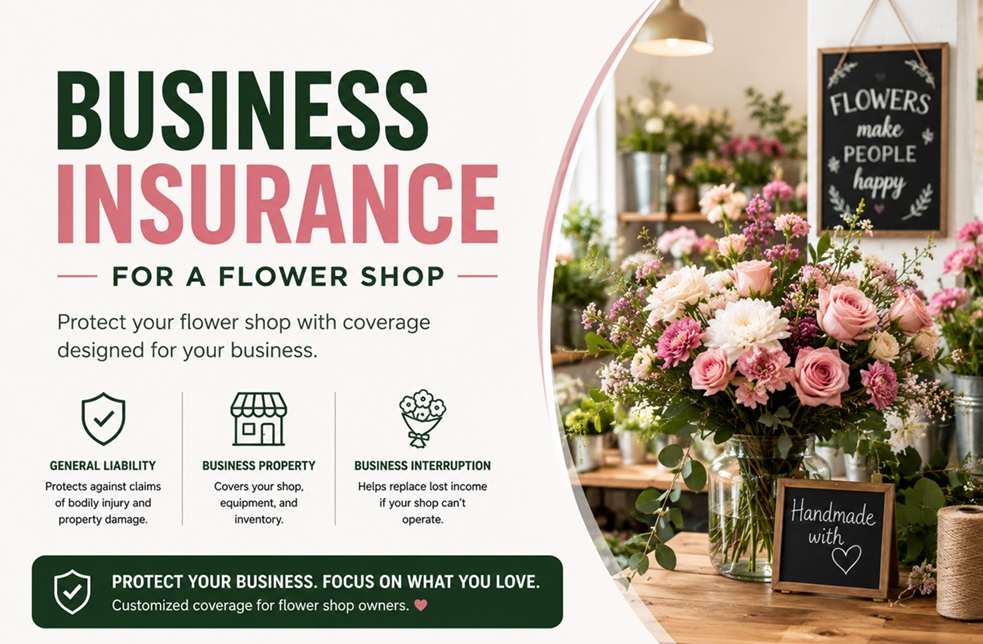
Running a flower shop comes with risks that most retail businesses don’t face — perishable inventory, refrigeration equipment, delivery vehicles, event liability, and the physical demands of a workspace filled with water and sharp tools.
The short answer: flower shops need a Business Owner Policy (BOP) as a foundation, supplemented by commercial auto if you make deliveries, workers’ comp if you have employees, and potentially event liability coverage if you handle weddings and large events.
Core Insurance Needs for a Flower Shop
| Coverage | Why Flower Shops Need It | Avg. Annual Cost |
| General Liability | Customer slips on wet floor, property damage during delivery | $500 – $900 |
| Commercial Property | Damage to refrigeration, tools, shop inventory | $400 – $800 |
| Business Interruption | Revenue loss if refrigeration fails or fire forces closure | Included in BOP |
| Commercial Auto | Delivery van, flower transport to events | $800 – $1,800 |
| Workers’ Compensation | Employee injuries from lifting, cutting tools, wet surfaces | Varies by state |
| Event Liability | Weddings, corporate events — claims after the event | $100 – $300/event |
The Refrigeration Problem: Why Standard Property Insurance Isn’t Enough
Flower shops live and die by their refrigeration. A standard commercial property policy covers the refrigerator itself if it’s damaged by a fire or storm — but it typically does NOT cover perishable inventory loss due to equipment breakdown.
Equipment breakdown insurance (also called boiler and machinery insurance) covers mechanical or electrical failure of equipment. For a flower shop, this means if your cooler compressor fails overnight, the coverage can reimburse the value of the spoiled flowers.
This is an add-on to your property or BOP policy, and for florists it’s genuinely worth having. Losing $3,000–$8,000 in inventory to a cooler failure is not uncommon.
Event and Wedding Liability
If your shop provides floral arrangements for weddings, corporate events, or other large occasions, the liability exposure is higher than standard retail. A mistake in a wedding arrangement, wilted flowers at a reception, or a delivery that doesn’t arrive on time can result in claims far exceeding the cost of the flowers.
Some florists add a special event liability endorsement to their GL policy. Others purchase standalone event liability coverage per event. The latter works well if events are occasional; the endorsement is better for shops where events are a regular part of business.
Delivery Coverage: Don’t Rely on Personal Auto
If you or an employee drives to deliver flowers, you need commercial auto coverage. Accidents during deliveries are not covered by personal auto policies.
For shops that use personal vehicles for occasional deliveries, a hired and non-owned auto endorsement to your GL policy can provide coverage at a lower cost than a full commercial auto policy. This works if deliveries are infrequent; a delivery van used daily needs its own commercial auto policy.
What a BOP Typically Costs for a Flower Shop
| Shop Size | Avg. Annual BOP Cost |
| Home-based or very small (under $50K inventory) | $600 – $900 |
| Small retail location (up to $150K inventory/equipment) | $900 – $1,500 |
| Established shop with delivery and events | $1,500 – $2,500 |
Practical Tips for Flower Shop Owners
Document your inventory value. Insurers need to know how much your flowers, supplies, and equipment are worth to set accurate coverage limits. Underinsuring your inventory is a common mistake.
Ask specifically about spoilage coverage. Not all BOPs include it. Make sure your policy either includes equipment breakdown or you’ve added it as a rider.
Review before peak seasons. Valentine’s Day and Mother’s Day see dramatically higher inventory levels. Make sure your coverage reflects that temporary spike.
Flower shop insurance isn’t dramatically different from general retail — but the perishable inventory, delivery exposure, and event work create specific gaps that standard policies often don’t address by default. Work with an insurer or broker who has experience with retail or specialty food/perishable businesses for the best fit.
